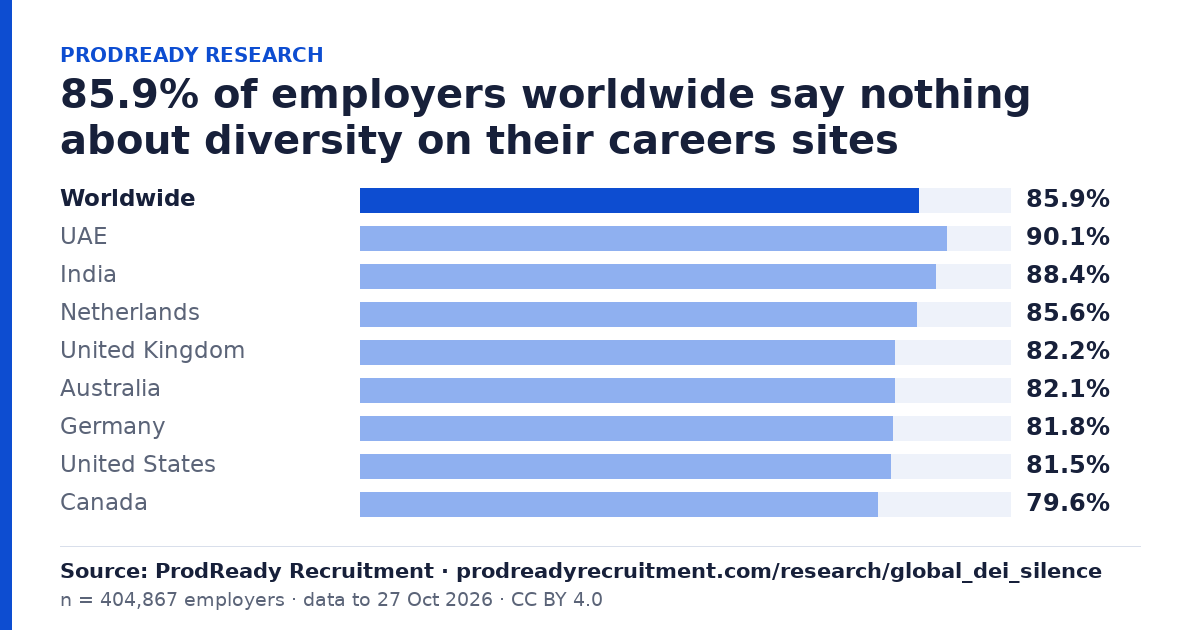
85.9% of employers worldwide say nothing about diversity on their careers sites
We read the careers sites of 404,867 employers around the world for diversity, equality and equal-opportunities statements, and for any mention of LGBT+ staff.
Data to 27 October 2026
By James Costello, Founder · last updated 27 October 2026
As companies argue over diversity, equity and inclusion, most employers have stopped short of saying anything at all. Of 404,867 employers worldwide whose careers sites we read, 85.9% carry no diversity, equality or equal-opportunities statement on any page.
Mentions of LGBT+ staff are rarer still: 0.2% of employers say they include LGBT+ people, through a staff network, Stonewall-style membership or by naming them among the people they welcome.
By country
Employers in the United Arab Emirates are the most silent (90.1% say nothing); those in Ireland the least (76.4%).
United Arab Emirates: 90.1% say nothing (9.9% publish a statement)
India: 88.4% say nothing (11.6% publish a statement)
Singapore: 87.5% say nothing (12.5% publish a statement)
Philippines: 87.5% say nothing (12.5% publish a statement)
Netherlands: 85.6% say nothing (14.4% publish a statement)
South Africa: 84.8% say nothing (15.2% publish a statement)
United Kingdom: 82.2% say nothing (17.8% publish a statement)
Australia: 82.1% say nothing (17.9% publish a statement)
Germany: 81.8% say nothing (18.2% publish a statement)
United States: 81.5% say nothing (18.5% publish a statement)
France: 81% say nothing (19% publish a statement)
Canada: 79.6% say nothing (20.4% publish a statement)
Ireland: 76.4% say nothing (23.6% publish a statement)
How we measured it
We read every English-language careers page and job advert we hold for employers worldwide, leaving out job boards, recruitment agencies and staffing firms. A statement is any equal-opportunities, diversity, equality or inclusion commitment; in the United States the common "Equal Opportunity Employer" line, often a legal requirement, counts. An LGBT+ mention is a staff network, a membership or award, or LGBT+ people named among those the employer welcomes; services for LGBT+ people do not count. An employer's country is given only where its pages clearly say where it is. The United Kingdom row comes from this worldwide sample; it is not the figure from our separate study of UK employers' own careers pages, which reads a different set of employers. This is what employers publish, not what they practise. The full methodology below sets out exactly what counts, what does not, and how often our reading is wrong.
In every country we measure, most employers' careers pages are silent on diversity. The differences are in who speaks.
— James Costello, Founder, ProdReady Recruitment
Headline
85.9%
85.9% of employers worldwide say nothing about diversity or equal opportunities on their careers sites; 0.2% mention including LGBT+ staff (n=404,867 employers).
Sample: 404,867 employers · source: employers' careers sites worldwide · data to 27 October 2026
By country
Country
Figure
Sample (employers)
In words
United Arab Emirates
90.1%
2,128
United Arab Emirates: 90.1% of employers say nothing about diversity or equal opportunities on their careers sites (n=2,128 employers).
India
88.4%
11,952
India: 88.4% of employers say nothing about diversity or equal opportunities on their careers sites (n=11,952 employers).
Philippines
87.5%
457
Philippines: 87.5% of employers say nothing about diversity or equal opportunities on their careers sites (n=457 employers).
Singapore
87.5%
886
Singapore: 87.5% of employers say nothing about diversity or equal opportunities on their careers sites (n=886 employers).
Netherlands
85.6%
1,269
Netherlands: 85.6% of employers say nothing about diversity or equal opportunities on their careers sites (n=1,269 employers).
South Africa
84.8%
361
South Africa: 84.8% of employers say nothing about diversity or equal opportunities on their careers sites (n=361 employers).
United Kingdom
82.2%
41,222
United Kingdom: 82.2% of employers say nothing about diversity or equal opportunities on their careers sites (n=41,222 employers).
Australia
82.1%
1,731
Australia: 82.1% of employers say nothing about diversity or equal opportunities on their careers sites (n=1,731 employers).
Germany
81.8%
1,972
Germany: 81.8% of employers say nothing about diversity or equal opportunities on their careers sites (n=1,972 employers).
United States
81.5%
84,465
United States: 81.5% of employers say nothing about diversity or equal opportunities on their careers sites (n=84,465 employers).
France
81%
910
France: 81% of employers say nothing about diversity or equal opportunities on their careers sites (n=910 employers).
Canada
79.6%
6,646
Canada: 79.6% of employers say nothing about diversity or equal opportunities on their careers sites (n=6,646 employers).
Ireland
76.4%
1,109
Ireland: 76.4% of employers say nothing about diversity or equal opportunities on their careers sites (n=1,109 employers).
Full methodology
How every figure on this page was produced, what counts and what does not, and how often our reading is wrong. Data to 27 October 2026; reader version 34.
1. What we read
Our crawler visits employer websites and keeps their careers pages: addresses such as /careers, /jobs or careers.example.com, the pages they link to, and the job adverts on them. It reads up to 30 pages per website, no more than three links deep. We read the text of each page as it was served, including navigation and footers. Text inside images and PDFs, and content a browser only loads with JavaScript after the page opens, is not read. Pages were read between 15 May 2026 and 27 October 2026.
2. Who is in the sample
Employers only. We leave out recruitment agencies, staffing firms, job boards and applicant-tracking platforms, which publish other companies' jobs. We identify them with our own website classifier and a manually maintained list. We also leave out any site whose pages name two or more other companies as the hirer (aggregators and investors' portfolio job boards), and any single page that is another company's advert.
English-language pages. Our reader works in English, so an employer is in the sample when at least one of its pages is in English: at least 30 words, at least 8% of them among the 20 most common English words ("the", "and", "you", "our" and so on). Its pages in other languages are not read. An employer with no English page is not in the sample at all, rather than being counted as silent.
One employer counts once, however many pages we read for it.
That leaves 404,867 employers worldwide.
3. When an employer "says something"
An employer counts as publishing a statement when at least one of its English pages contains any of the following. Everything else counts as saying nothing. On a job advert with structured data we read the advert and the page around it, because the equal-opportunity line usually sits in the page footer.
Equal opportunity wording: "equal opportunity employer" or "equal opportunities employer"; "EOE"; "EEO" as a line of its own; "provides equal employment opportunities"; "all qualified applicants will receive consideration without regard to race, colour, religion…"; "affirmative action employer"; an equal opportunities policy.
A diversity, equity or inclusion commitment: "committed to diversity", equality or inclusion; "diversity and inclusion" or "diversity, equity and inclusion"; D&I, DE&I, ED&I; "we value", celebrate or embrace diversity; an "inclusive workplace", employer, culture or environment; a "diverse workforce".
Who is welcome: "we welcome applications from all", from everyone, or from under-represented groups; the UK "Disability Confident" scheme.
Non-discrimination: "regardless of race, religion, gender…"; and "will not discriminate" or "without regard to race…" in the same sentence as an employment word such as applicants, hiring, employment or positions.
In the United States the "Equal Opportunity Employer" line is common and is often a legal requirement for federal contractors. It still counts as a statement, so part of the gap between countries reflects law rather than choice.
4. What does not count
The same words used about something else: EEO compliance, training or reporting as a job duty; US labour-law poster lists ("EEO is the Law", polygraph notices); privacy notices about personal data; equal housing opportunity.
"Diversity" that is not about people at work: "biodiversity", "a diversity of projects", "a diverse client base".
"EDI" or "DEI" alone, because EDI is just as often Electronic Data Interchange. These count only with a diversity, equality or inclusion word in the same sentence.
Statements elsewhere on a company's website, such as annual reports, ESG or investor pages, are not seen unless they are part of the careers pages we read.
5. LGBT+ mentions
An employer mentions LGBT+ staff when its pages describe an LGBT+ or Pride staff network, membership of or an award from a workplace-equality scheme such as Stonewall, or name LGBT+ people among those it welcomes or includes, beside a staff or workplace word. Services for LGBT+ people, exhibitions, "Pride and Prejudice" and "take pride" do not count.
6. Which country an employer is in
A .com address says nothing about country, so we use what the pages say: currency, phone codes, postcodes and ZIP codes, city and country names, and country-only terms such as 401(k) or superannuation. Points are added up across all of an employer's pages. We assign a country only when one country has at least 3 points and at least twice the points of the next, so unclear and multinational employers are left unassigned rather than guessed. The "Equal Opportunity Employer" line is never used as evidence of the United States, so the country figures cannot be produced by the thing they measure. A country appears in the table only with at least 50 employers. The United Kingdom row comes from this worldwide sample. It is not the figure from our separate study of UK employers' careers pages, which reads a different set of employers.
7. How accurate is it?
On 28 October 2026 we checked a random sample, drawn evenly across employers, against what their pages actually say:
400 employers counted as saying nothing. We searched every page we read for them for any diversity-related word and read each passage found. 300 had no such wording at all. 13 (3.3%) had a statement our reader missed, such as "committed to the principle of equality in employment", or a non-discrimination notice placed straight after a list of jobs. A further 17 (4.3%) used loose wording, such as "an inclusive team culture", that could be read either way.
200 employers counted as publishing a statement. We read the passage that triggered each one. 7 (3.5%) were wrong, such as "we welcome applications from all carers" or a consultant's CV listing diversity work. A further 5 were borderline.
The two errors do not cancel out. The error rates are similar, but far more employers are counted as silent than as speaking, so the missed statements outnumber the false ones and the published share of employers saying nothing is likely a little high. Correcting for the clear errors gives about 83.6% worldwide, against the 85.9% we publish. Counting the borderline wording as statements as well gives about 80%. With samples of this size, each error rate is accurate to within about two to three percentage points. We publish the reader's figure, not the corrected one, so that every number on this page comes from the same rule applied the same way to every employer.
8. Limits
This measures what employers publish on their careers pages, not what they practise.
English-language pages only, so the sample leans towards countries where English is used at work.
We read the careers pages we could find. Some employers keep jobs on another company's recruitment platform or load them in ways our crawler cannot read, and some employers will have pages we did not reach.
Pages change. A page read in May may say something different today.
About the author
James Costello
Founder, ProdReady Recruitment
The research is produced by the founder of ProdReady Recruitment, a UK AI recruitment business. Every figure on this page is computed from employers' careers sites worldwide, and the text-reading measures are checked by hand against real pages.
James Costello (2026). The diversity silence worldwide. ProdReady Recruitment. Data to 27 October 2026. https://ProdReadyRecruitment.com/research/global_dei_silence
Need a custom cut?
Journalists and analysts can ask for the figure for any country we measured, or the underlying table.