
Global

OpenAI leads in job adverts worldwide, but Claude is ahead in the United States and Canada

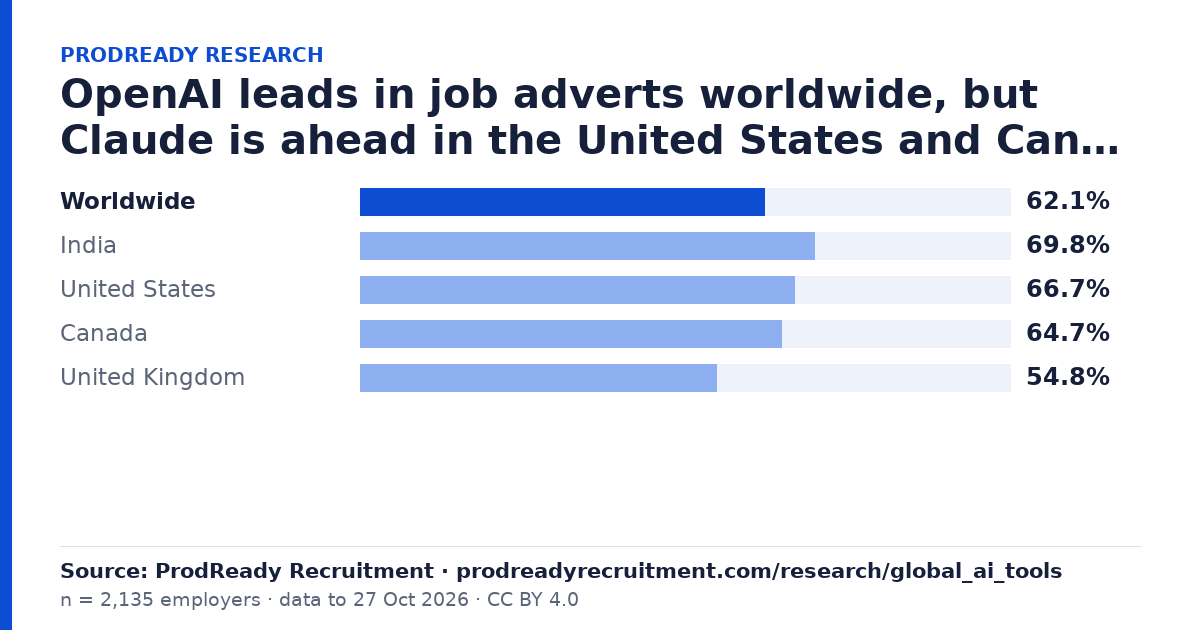
We read the job adverts on employers' own careers sites worldwide. Of 2,135 employers whose adverts name an AI tool, 62.1% name ChatGPT / OpenAI and 58.1% name Claude / Anthropic.

Data to 27 October 2026
James Costello
By James Costello, Founder · last updated 27 October 2026

Two families dominate. Of the 2,135 employers worldwide whose job adverts name an AI tool, 62.1% name OpenAI's tools (ChatGPT, Codex or the OpenAI API) and 58.1% name Anthropic's (Claude or Claude Code). No other tool is named by more than a quarter of them.

The race is closer country by country. In the United States and Canada, employers now name Claude more often than OpenAI's tools; in the other countries with enough employers to measure, OpenAI is level or ahead.

By country

  1. India: Claude 49.7%, OpenAI 69.8% (288 employers naming a tool)
  2. United States: Claude 66.7%, OpenAI 63.4% (505 employers naming a tool)
  3. Canada: Claude 64.7%, OpenAI 57.8% (102 employers naming a tool)
  4. United Kingdom: Claude 52.9%, OpenAI 54.8% (155 employers naming a tool)

Every AI tool employers name

  1. ChatGPT / OpenAI: 62.1%
  2. Claude / Anthropic: 58.1%
  3. LangChain: 20%
  4. Cursor: 19.2%
  5. Google Gemini: 16.3%
  6. GitHub Copilot: 14.9%
  7. Microsoft Copilot: 12.7%
  8. Hugging Face: 7.8%
  9. Midjourney / image generators: 5.9%
  10. Meta Llama: 2.1%
  11. Mistral: 1.6%
  12. Chinese models (DeepSeek, Qwen …): 1%

How we measured it

We read the job adverts on the careers sites of employers worldwide, hundreds of thousands of them, and recorded the AI tools and model families each advert names in the role's own text: the tools the role uses, the skills it asks for or the team's stack. Blog headlines, news sidebars, customer lists, rules for candidates and recruitment-process text do not count, nor do job boards, investor portfolio boards, recruitment agencies or the AI vendors' own sites. OpenAI includes ChatGPT, Codex and the OpenAI API; Anthropic includes Claude and Claude Code. An employer's country is given only where its pages clearly say where it is. The United Kingdom row comes from this worldwide sample; it is not the figure from our separate study of UK employers' own careers pages, which reads a different set of employers. We checked a sample of flagged adverts by hand. An employer counts once however many adverts name a tool.

Across countries, the same handful of AI tool names dominate job adverts. The exceptions — which country names which tool — are where the story is.
— James Costello, Founder, ProdReady Recruitment
Headline
62.1%

Of 2,135 employers worldwide whose job adverts name an AI tool, 62.1% name ChatGPT / OpenAI; 58.1% name Claude / Anthropic.

Sample: 2,135 employers · source: employers' careers sites worldwide · data to 27 October 2026

By country

CountryFigureSample (employers)In words
India 69.8% 288 India: ChatGPT / OpenAI is named by 69.8% of employers whose job adverts name an AI tool (n=288 employers).
United States 66.7% 505 United States: Claude / Anthropic is named by 66.7% of employers whose job adverts name an AI tool (n=505 employers).
Canada 64.7% 102 Canada: Claude / Anthropic is named by 64.7% of employers whose job adverts name an AI tool (n=102 employers).
United Kingdom 54.8% 155 United Kingdom: ChatGPT / OpenAI is named by 54.8% of employers whose job adverts name an AI tool (n=155 employers).

By AI tool

TopicFigureSample (employers)In words
ChatGPT / OpenAI 62.1% 2,135 ChatGPT / OpenAI: named by 62.1% of employers worldwide whose job adverts name an AI tool (n=2,135 employers).
Claude / Anthropic 58.1% 2,135 Claude / Anthropic: named by 58.1% of employers worldwide whose job adverts name an AI tool (n=2,135 employers).
LangChain 20% 2,135 LangChain: named by 20% of employers worldwide whose job adverts name an AI tool (n=2,135 employers).
Cursor 19.2% 2,135 Cursor: named by 19.2% of employers worldwide whose job adverts name an AI tool (n=2,135 employers).
Google Gemini 16.3% 2,135 Google Gemini: named by 16.3% of employers worldwide whose job adverts name an AI tool (n=2,135 employers).
GitHub Copilot 14.9% 2,135 GitHub Copilot: named by 14.9% of employers worldwide whose job adverts name an AI tool (n=2,135 employers).
Microsoft Copilot 12.7% 2,135 Microsoft Copilot: named by 12.7% of employers worldwide whose job adverts name an AI tool (n=2,135 employers).
Hugging Face 7.8% 2,135 Hugging Face: named by 7.8% of employers worldwide whose job adverts name an AI tool (n=2,135 employers).
Midjourney / image generators 5.9% 2,135 Midjourney / image generators: named by 5.9% of employers worldwide whose job adverts name an AI tool (n=2,135 employers).
Meta Llama 2.1% 2,135 Meta Llama: named by 2.1% of employers worldwide whose job adverts name an AI tool (n=2,135 employers).
Mistral 1.6% 2,135 Mistral: named by 1.6% of employers worldwide whose job adverts name an AI tool (n=2,135 employers).
Chinese models (DeepSeek, Qwen …) 1% 2,135 Chinese models (DeepSeek, Qwen …): named by 1% of employers worldwide whose job adverts name an AI tool (n=2,135 employers).

About the author

James Costello
James Costello
Founder, ProdReady Recruitment

The research is produced by the founder of ProdReady Recruitment, a UK AI recruitment business. Every figure on this page is computed from employers' careers sites worldwide, and the text-reading measures are checked by hand against real pages.

LinkedIn

Download the data

Free under CC BY 4.0 — use it with attribution. Every row carries the figure, its sample and the data-to date.

CSV for this story All findings (CSV)

Use the chart

OpenAI leads in job adverts worldwide, but Claude is ahead in the United States and Canada

Free to publish under CC BY 4.0, with a credit and a link to this page.

Download PNG

Cite this

Free to quote with a credit and a link.

James Costello (2026). The AI tools employers name worldwide. ProdReady Recruitment. Data to 27 October 2026. https://ProdReadyRecruitment.com/research/global_ai_tools

Need a custom cut?

Journalists and analysts can ask for the figure for any country we measured, or the underlying table.

Ask us

Related research